· planning · 12 min read
How Do Ice Caves Form in Iceland? A Plain Explanation From a Jökulsárlón Guide
Summer meltwater carves tunnels through Vatnajökull; autumn cold empties and firms them into blue caves that last one winter. From a Jökulsárlón guide.
Ice caves in Iceland form when summer meltwater carves channels on, into and under a glacier, and the autumn cold then cuts the flow off — the emptied tunnels firm up into caves you can walk through. This happens in Vatnajökull's outlet glaciers, such as Breiðamerkurjökull above Jökulsárlón, which is why the season runs roughly October to April and why no cave survives the following summer. Written by Sindri, who has guided ice cave tours from Jökulsárlón since 2015.
I'm Sindri. My wife Fanney and I run Glacier Trips, a small family company in Höfn in South-East Iceland, and we've guided ice cave tours from Jökulsárlón since 2015. I'm not a glaciologist, but "how did this actually form?" is the question guests ask most once the first photos are taken. The plain-language answer starts with snow that fell centuries ago and ends with a river that stops.
Where does the ice in an ice cave come from?
From snow, compressed for centuries. Snow falls on Vatnajökull, Europe's largest ice cap, and each winter's fall presses on the layers beneath until the buried snow becomes dense glacier ice. The walls you photograph inside a cave are centuries-old ice — snow that fell long before anyone was guiding tours here.
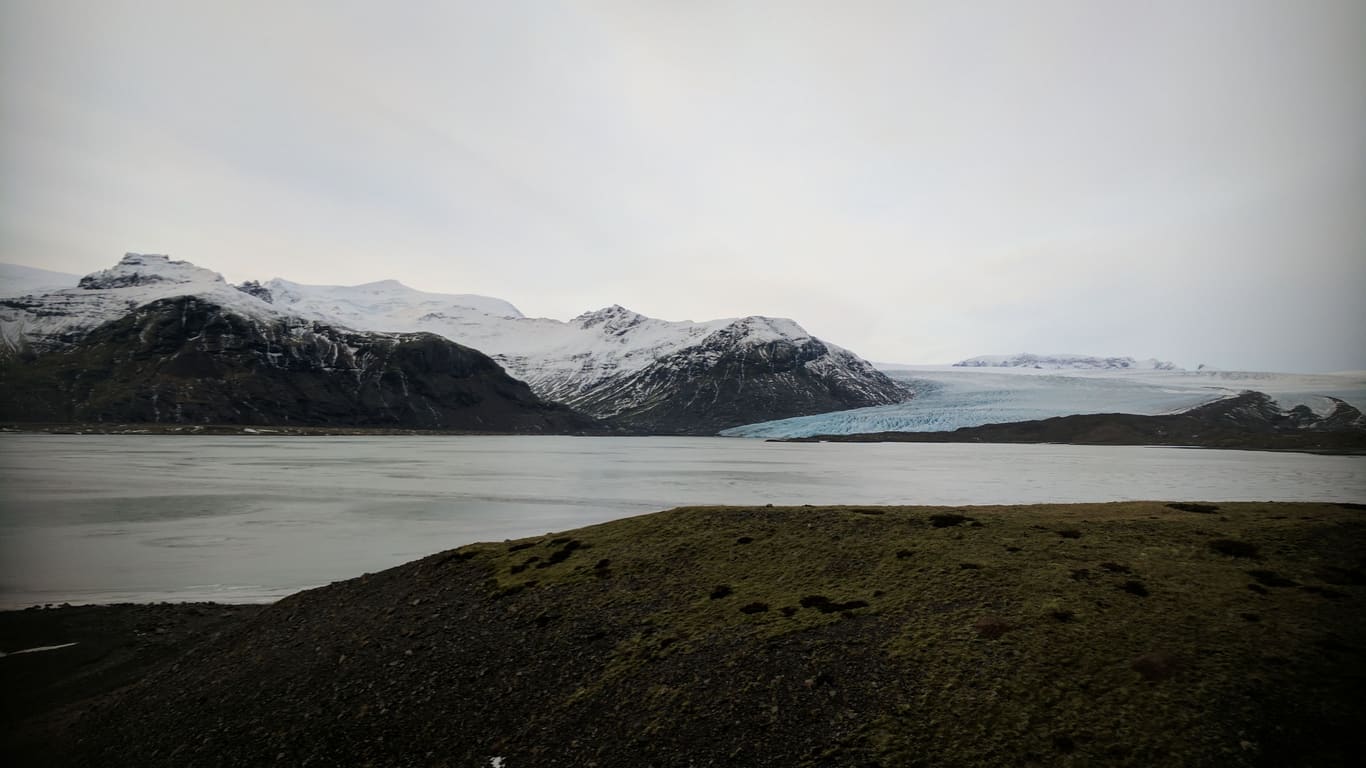
A glacier never sits still either: ice flows slowly downhill under its own weight, and Vatnajökull drains through outlet glaciers — slow rivers of ice. The caves we guide form in outlets such as Breiðamerkurjökull, which flows down toward Jökulsárlón glacier lagoon. That movement cracks the ice open for water to enter, and it carries old ash layers along inside the glacier (more on those below).
How does meltwater carve a cave?
Summer does the digging. The glacier's surface melts, and the water has to go somewhere: some runs off the top, and a great deal pours into the ice through cracks, crevasses and vertical shafts (glaciologists call those moulins), then works its way through and under the glacier toward its edge. Flowing water melts the ice around it, so every path widens as summer goes on — a river carving a canyon, only quicker, because these walls melt.
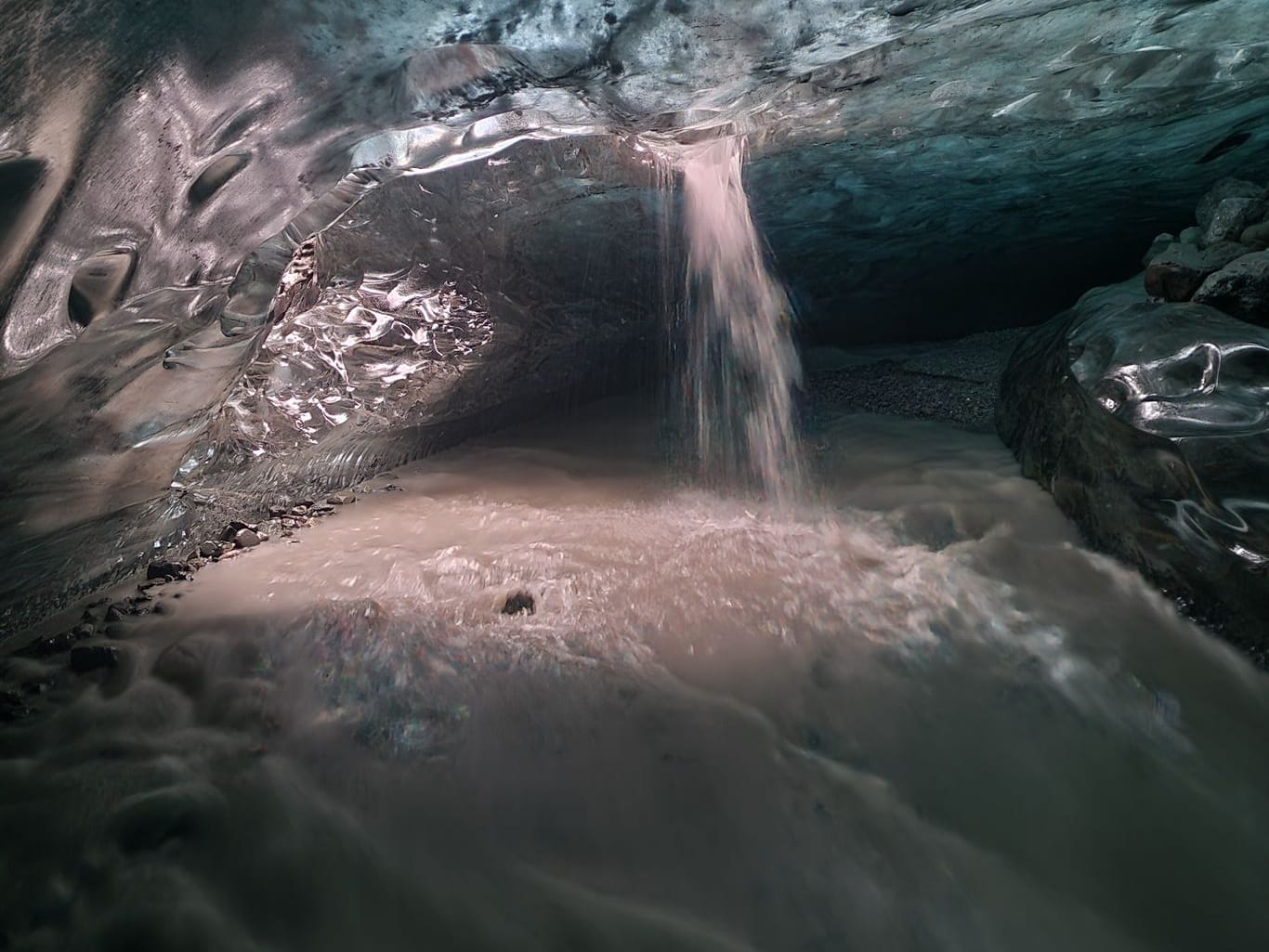
Those drainage channels are the future ice caves — in summer, dark tunnels full of moving water, growing and shifting by the day. Every cave we guide is the ghost of a summer river. When you walk into a blue cave in January, you're walking up the middle of a channel that meltwater was roaring through in July; the smooth, scalloped ceiling is the water's work.
What turns a flooded tunnel into a walkable cave?
The autumn cold. When temperatures drop, the surface melt slows and the water feeding those channels dries up: the flow stops and the tunnels drain. The ice around the emptied passages hardens, and what was a working drainpipe in August stands by October as a still, firm-walled cave. A small stream sometimes trickles along a cave floor all winter — that's normal; it's the summer flood that rules a cave out, not water itself.
That timetable is the whole reason the season exists: tours run roughly October to April because that's when the caves are drained and firm. Our 2026–27 winter runs from 1 October to April and the whole season is bookable now — the season preview has the detail, and do ice cave tours run year-round has the longer answer on why nothing runs in summer.
Why is the ice blue?
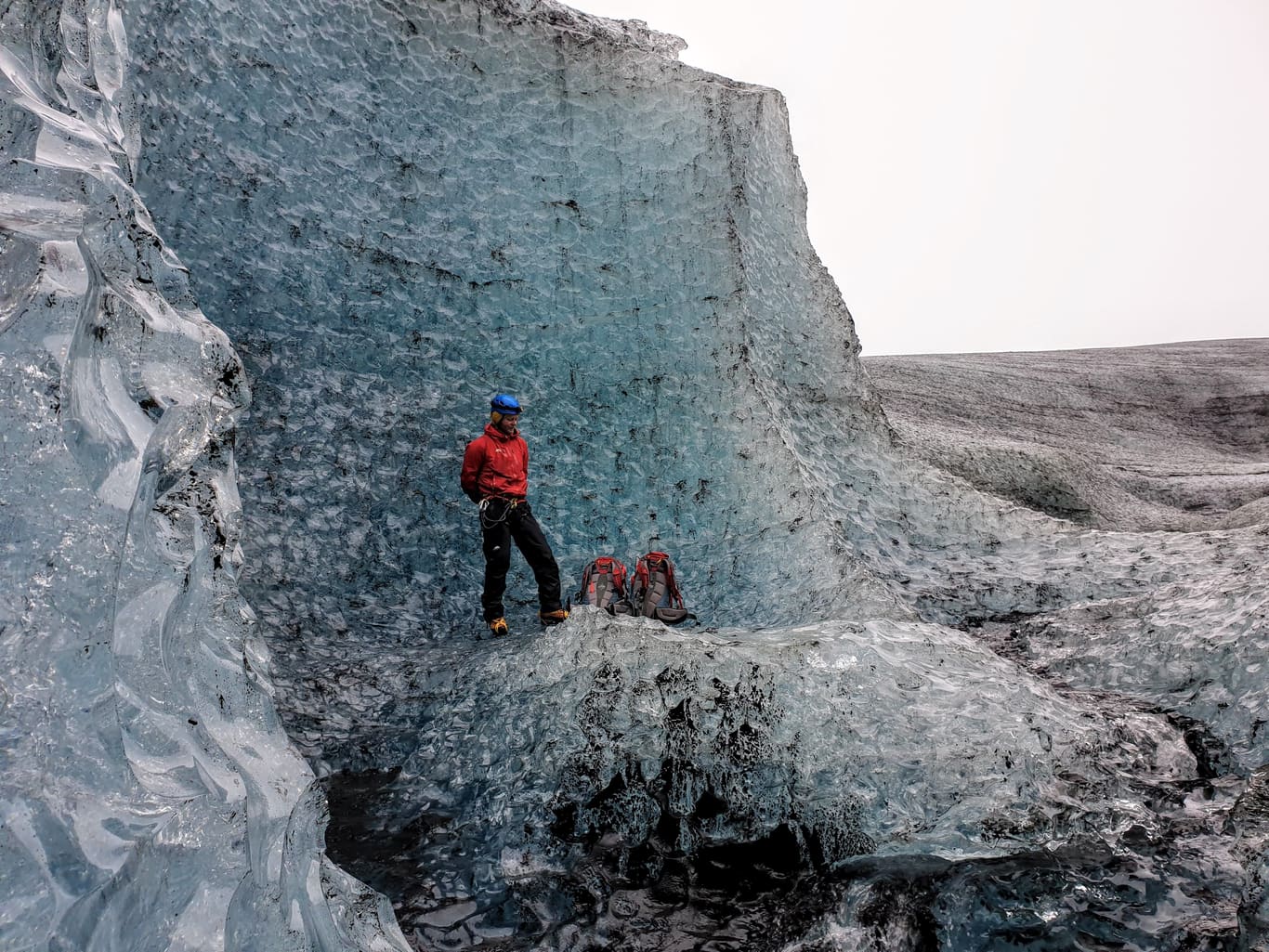
Because old glacier ice swallows the red end of the light. Fresh snow is white: it's full of trapped air, and all those tiny bubbles scatter every colour straight back at you. Centuries of compression squeeze the air out, so light travels deep into the ice instead of bouncing off the surface — and ice absorbs red and yellow light more strongly than blue. The further light travels before finding its way out, the more of the red end is gone. What returns to your eye is blue.
The colour therefore tracks the ice itself: the denser and deeper the ice, the deeper the blue. Nothing is lit or dyed — the blue is simply what centuries-old ice does to daylight, and an overcast day often gives a richer blue than hard sunshine.
Why do some caves have skylights?
Because the roof has a history too. Some openings are the shafts summer meltwater poured down into the glacier — a moulin meeting the cave from above. Others form where the water carved the ceiling thin and the thin stretch later melted through or fell in. Guides call these skylights, and they change a cave's character completely: an enclosed cave glows blue from its walls, while a skylight cave holds a column of white daylight. Neither is better — which kind a winter produces is decided by where the summer's water went.
What are the dark bands in the ice?
Volcanic ash. Iceland's eruptions drop ash across its glaciers, and each layer lies on the surface until new snow buries it. The glacier keeps flowing, and the moving ice slowly folds those buried layers into itself, stretching and tilting them. When meltwater later carves a cave through the ice, the walls expose the old eruptions as thin dark bands running through the blue — sometimes in curves so regular they look drawn on.
In the caves we guide, the bands stay thin and the blue stays dominant. The extreme case is Kötlujökull near Vík, which sits directly on the volcano Katla and carries so much ash that its cave ice reads dark rather than blue — we compared the two looks honestly in Vatnajökull vs Katla.
Why does every ice cave disappear in summer?
Because the water comes back. The spring melt refloods the drained channels, and the cave that stood all winter is reshaped or washed away entirely. By the time the next autumn firms the glacier up, the meltwater has often taken a different path, so what appears in October is a new cave — different spot, different shape, different mood.
Two honest consequences follow. The cave in last winter's photos, ours included, no longer exists in that form. And no operator can promise you a specific cave: the glacier decides each summer what there will be to visit, and everyone finds out in autumn. There's a longer piece on what happens to an ice cave across one winter; if your dates are flexible, the best month to visit breaks the season down.
How is a cave judged safe to enter?
Fresh, every morning, and jointly. In season, cave conditions are checked every morning together with the other local operators and Vatnajökull National Park, and the day's safest cave is chosen before any group goes in. Yesterday's assessment never carries over, because a mild spell or heavy rain can change a cave overnight — the same daily judgement is why a tour is sometimes cancelled for safety, in which case you choose a full refund or a new date.
The same caution gives the season its soft edges: October caves are the youngest, April caves live on borrowed time, and the exact first and last departures follow conditions, not the calendar. More in is an ice cave tour in Iceland safe.
Want to stand inside one?
Reading the physics is one thing; standing inside the ghost of a summer river is better. We run two tours from Jökulsárlón, October to April:
- Ice Cave Inside Vatnajökull — 2.5–3 hours, max 14 guests, ages 8 and up, 23,900 ISK. Super Jeep from Jökulsárlón onto the glacier and into a natural blue cave.
- Ice Cave Adventures Dream — 5–6 hours, max 8 guests, ages 14 and up, 36,900 ISK. Adds a proper glacier hike for those who want longer on the ice.
Both meet at the main parking area by Jökulsárlón Glacier Lagoon — the National Park's lot, where a parking fee applies. We don't do pickups, and the lagoon is about 5 hours' drive from Reykjavík; the meeting point is mapped on our location page. Two useful follow-ups: how long you actually spend inside the cave, and the tour FAQ for practical details.
Every booking has free cancellation up to 48 hours before departure, and the code DIRECT5 takes 5% off when you book direct. Questions about the ice itself are welcome too — email info@glaciertrips.is or call +354 779 2919 and you'll get an answer from someone who spends the winter inside these caves.

Frequently asked questions about how ice caves form
How long does it take for an ice cave to form?
One melt season carves the cave: summer meltwater cuts the channel, and the autumn cold drains and firms it into a walkable cave by October. The ice being carved is far older — dense glacier ice compressed from snowfall over centuries.
Why is glacier ice blue?
Dense, centuries-old glacier ice has had nearly all its air squeezed out, so light travels deep into it, and ice absorbs the red end of light more strongly than the blue. What comes back out looks blue — and the denser and deeper the ice, the deeper the blue.
Are Iceland's ice caves natural?
The blue winter caves in Vatnajökull are entirely natural — carved by summer meltwater and firmed up by autumn cold, with nothing dug or lit. That is also why each one lasts a single winter. Iceland does have one man-made ice tunnel, in Langjökull, which is a different experience.
Do ice caves form in the same place every year?
Sometimes roughly, never exactly. Meltwater often favours similar routes through a glacier, so caves can re-form in the same general area for a few winters. But each year's cave is new, and no operator can promise a specific cave — the summer's melt decides what exists.
What are the dark stripes in ice cave walls?
Volcanic ash. Eruptions drop ash onto the glacier, snow buries each layer, and the moving ice folds them in. A cave carved through that ice shows them as thin dark bands in the blue. Glaciers sitting on active volcanoes, like Katla's, carry far heavier banding.
Why do some ice caves have holes in the roof?
Those are skylights. Some are the shafts summer meltwater poured down into the glacier; others open where the water carved the roof thin and the ceiling later melted through or fell in. A skylight fills a cave with daylight, so it photographs very differently from an enclosed blue chamber.
Who decides whether an ice cave is safe to enter?
In season, cave conditions are checked every morning together with the other local operators and Vatnajökull National Park, and the day's safest cave is chosen before any group goes in. If conditions fail the morning check, tours are cancelled and guests choose a full refund or a new date.
The short version: summer water builds the caves, autumn cold opens them, and the next summer's water takes them back. The blue, the ash bands, the skylights and the October-to-April calendar all follow from that one cycle. For the wider picture, start with our guide to ice caves in Iceland, and if you're still weighing the trip, is an ice cave tour worth it gets an honest answer too.
— Sindri
Glacier Trips · Höfn, Iceland · A local family company since 2015