· planning · 12 min read
What's the Difference Between an Ice Cave and an Ice Arch? A Glacier Glossary
An ice cave is an enclosed passage inside a glacier. An ice arch is open ice you see daylight through — and never stand under. A guide's plain glossary.

An ice cave is an enclosed passage inside a glacier: meltwater carves it through the summer, the walls and ceiling are ice all the way round, and a few steps past the entrance it gets properly dark. An ice arch is the opposite — an open span of ice you can see daylight through from the other side, and it belongs in your photos, never over your head, because spans collapse without warning. Our winter tours go inside proper caves, guided only; arches stay in the viewfinder. Written by Sindri, who has guided ice cave tours on Vatnajökull since 2015.
I'm Sindri. My wife Fanney and I run Glacier Trips, a small family company in Höfn in South-East Iceland, and I've driven guests from Jökulsárlón into the caves of Vatnajökull every winter since 2015. The words arrive muddled, though: guests book an "ice cave" off a photo of an arch, and tour listings don't always help. Here is the glossary I'd give you in the Super Jeep — plain language, one safety line underlined.
What counts as an ice cave?
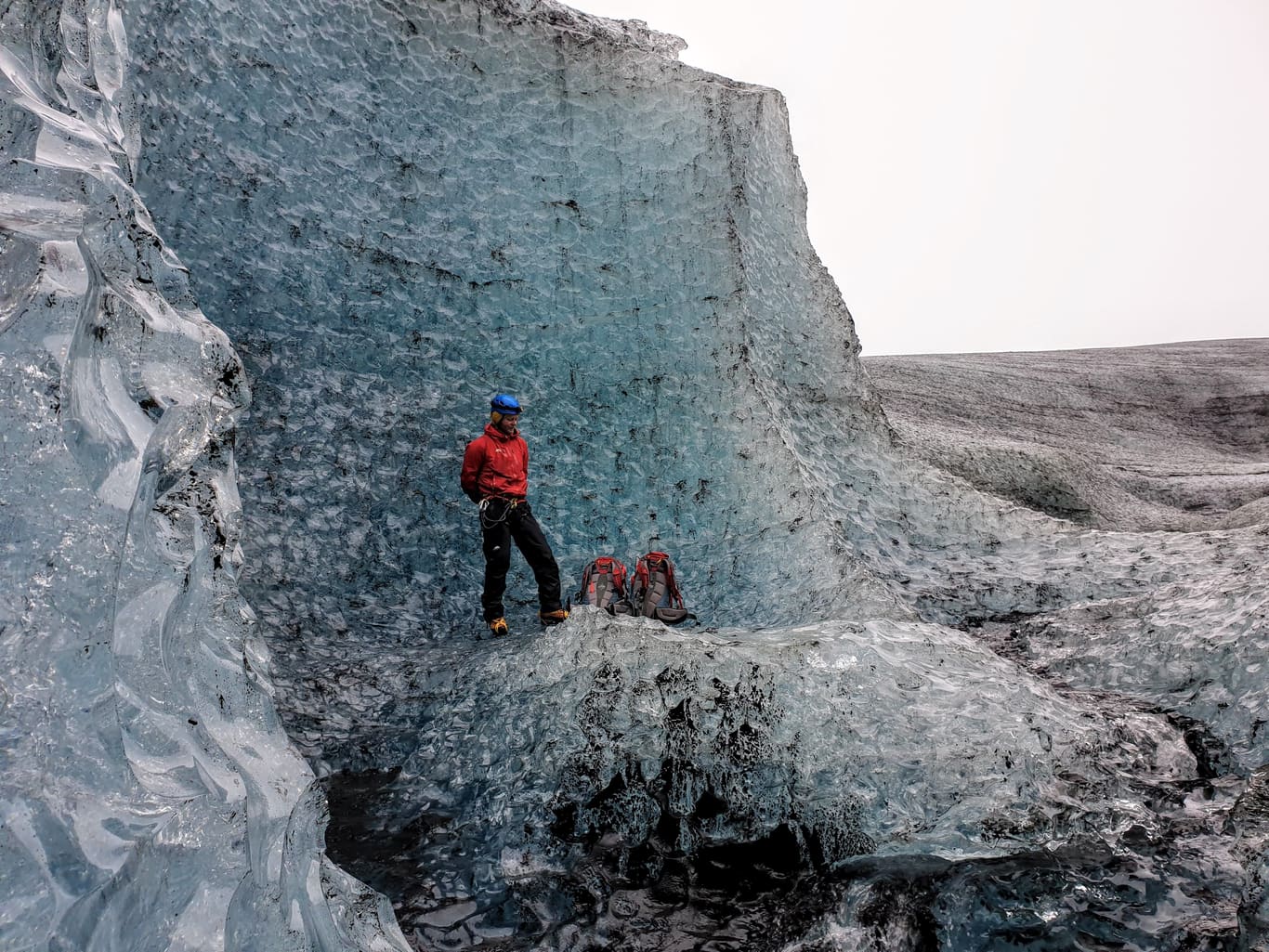
An ice cave is an enclosed passage inside the body of the glacier. Summer meltwater carves a path through the ice; when the melt slows in autumn and the first cold snaps firm everything up, what's left is a roofed tunnel you can walk into. Walls, ceiling and usually the floor are ice, past the entrance it's genuinely dark — the reason headlamps are on our kit list for caves that need them — and the air inside sits around 0°C whatever the weather does outside. If a listing says "glacier cave", that's the same feature under its drier textbook name.
Two more things define a Vatnajökull cave. The colour: deep glacial ice absorbs the red end of the light and passes the blue — paler in October, deepest from December, with January–February the prime window. And the lifespan: each natural cave here lasts one winter — next summer's meltwater unmakes it. How ice caves form covers the carving, what happens to a cave across one winter follows the arc, and the guide to ice caves in Iceland is the wider map. On our short tour you spend roughly 30–45 minutes inside one; the season here runs October to April.

What's an ice arch, and why don't you stand under one?
An ice arch is ice you can see daylight through. It's an open-ended span — a bridge left standing where the ice around it has melted or fallen away — usually at a glacier's edge or snout, sometimes over a meltwater stream. The field test: if light comes through from the other side, it's an arch, not a cave.
Arches are often the most dramatic thing in view, and that's the trap. A cave is supported the whole way round, like a tube; an arch carries its weight on two shoulders and thins from every surface at once. When a span goes, it goes in one movement, with no useful warning. So our rule is absolute and a little boring: arches are photographed from a distance, on safe ground, and nobody walks under or into one, however solid it looks. Some of my favourite pictures from this glacier are of arches. Every one was taken well back.

Which glacier terms mean what?
Seven terms cover nearly everything you'll meet in a tour listing or caption; for each, the question that matters is the same.
| Term | What it is | Can you go in? |
|---|---|---|
| Ice cave | Enclosed, roofed passage inside the glacier, carved by meltwater | Yes — guided, in winter |
| Glacier cave | The same feature; the more technical name | Yes — same rules |
| Ice arch | Open span with daylight visible through it | No — photograph it from a distance |
| Crevasse | Crack opening downward from the glacier surface | No — viewed from a safe line on guided walks |
| Moulin | Vertical shaft where surface meltwater drains into the ice | No — admired from well back |
| Man-made ice tunnel | Dug into the glacier by machine; the known one is on Langjökull | Yes — open all year, a different thing from a natural cave |
| Iceberg caves and holes | Hollows in floating or stranded bergs at Jökulsárlón and Diamond Beach | Never — the ice can roll or split without notice |
Three of these trip people up. A crevasse is not a cave missing its roof: it opens from above, so the hazard is falling in, not ice overhead. The man-made tunnel on Langjökull is dug and maintained by people, which is why it can open all year — a real experience, but not a natural cave; do ice cave tours run year-round in Iceland untangles the two. And the iceberg caves at the lagoon and Diamond Beach have no guided version at all: a berg can roll or split without notice, afloat or aground. Enjoy them from the shore, or from a boat tour, which keeps its distance.
Why does the difference matter for your photos and your safety?
For photos, the two want opposite treatment. A cave is an interior: the glowing ceiling, a person small in the entrance for scale — photographing the ice caves and camera settings inside a cave cover that half, and the best month to visit explains the January–February blue. An arch is an exterior: the span silhouetted against the sky, shot from outside, often best in low afternoon light.
"Ice cave" has also been stretched over the years, and some tours sold under it visit arches, crevasse edges or open ice walls. If every photo in a listing is open to the sky, you're not being shown the inside of a glacier. Ask whether the main feature is enclosed or open; an honest operator will tell you.
For safety, the two words draw the line where your body can go. On our tours we photograph arches from safe ground and go inside proper caves only after the day's check: cave conditions are checked every morning — together with the other local operators and Vatnajökull National Park — before any group goes in. Some mornings the check moves us to a different cave; occasionally it cancels the day, and you choose a full refund or a free reschedule. How we decide which cave to visit each day walks through that morning, and are ice cave tours safe is the longer answer.
Where do our tours fit in?
Both our tours go inside natural, enclosed caves in Vatnajökull's outlet glaciers, reached by Super Jeep on 37–44 inch tyres from Jökulsárlón. The short Ice Cave Inside Vatnajökull tour is the focused version: 2.5–3 hours with roughly 30–45 minutes inside the cave. Adventures Dream is the long one: 5–6 hours, about 45–60 minutes inside, plus a guided glacier hike where crevasses and moulins are seen from a safe line. How long you spend inside an ice cave breaks the timings down.
A word on right now: the 2026–27 season opened on 1 October, and these opening weeks are the scouting phase — first cold snaps firming the ice, the smallest cave inventory of the winter, and us actively scouting between tours. The season preview covers what that means for an October booking; by December the choice widens and the blue deepens. If an arch stands near the route we'll stop for photos — from exactly as far away as everyone else.
Booking a guided ice cave tour
Both tours meet at the main parking area by Jökulsárlón Glacier Lagoon, where a parking fee applies. We don't do pickups, so nearly everyone drives.
- Ice Cave Inside Vatnajökull — 2.5–3 hours, maximum 14 guests, minimum age 8, 23,900 ISK. Includes a local guide, Super Jeep transport from Jökulsárlón to the glacier and back, micro spikes when needed, helmet, and headlamps if needed. Arrive 20 minutes before departure.
- Ice Cave Adventures Dream — 5–6 hours, maximum 8 guests, minimum age 14, 36,900 ISK. Adds a guided glacier hike, crampons, a harness when the route needs one, and an ice axe when needed. Arrive 30 minutes before departure.
The minimum ages are set by the safety plan we make for each tour, and the season runs 1 October to April. Cancellation is free up to 48 hours before departure with a full refund; inside 48 hours there's no refund; and if we cancel for weather or safety, you choose between a full refund and a free reschedule. The base price is the same direct as on the booking platforms, so use DIRECT5 for 5% off when you book direct. What to wear is its own page (start with the boots), and the tour FAQ, safety page and location page cover most of the rest; anything else goes to info@glaciertrips.is or +354 779 2919. We hold 4.9 stars across 580+ TripAdvisor reviews.
Frequently asked questions about ice caves, ice arches and glacier terms
What's the difference between an ice cave and an ice arch?
An ice cave is an enclosed, roofed passage inside the glacier — you walk in and it gets dark. An ice arch is an open span you can see daylight through from the other side. Guided winter tours go inside caves; arches are photographed from a distance and never stood under.
Is a glacier cave the same as an ice cave?
Yes — both names describe the same feature: a meltwater-carved passage whose walls and ceiling are glacier ice. "Glacier cave" is the more technical term; Icelandic listings nearly always say "ice cave". Either way it's natural, winter-only on Vatnajökull, and visited with a guide.
Can you walk under an ice arch if it looks solid?
No. Looks tell you nothing about an arch's strength — it thins from every surface, and a span can drop in one movement with no useful warning. We photograph arches from safe ground, with no exceptions for calm, clear mornings.
Is a crevasse a kind of ice cave?
No. A crevasse is a crack opening downward from the glacier surface — no roof, and the hazard is falling in from above. You see crevasses on a guided glacier hike, from a safe line the guide chooses.
Is the Langjökull ice tunnel a natural ice cave?
No — it's dug into the glacier and maintained, which is why it can open all year. The natural caves in Vatnajökull are meltwater-carved, each lasts one winter, and their season runs October to April. Both are real; only one is grown by the glacier.
Can you go inside the iceberg caves at Jökulsárlón or Diamond Beach?
Never. Those hollows sit in floating or stranded icebergs, and a berg can roll or split without notice, on water or on the sand. No operator runs tours into them; view them from the shore.
— Sindri
Glacier Trips · Höfn, Iceland · A local family company since 2015