· winter · 11 min read
Why Is Glacier Ice Blue? A Guide's Plain Answer
Dense glacier ice swallows the red end of daylight and hands back blue — no lamps, no dye. A Jökulsárlón guide explains the colour, month by month.
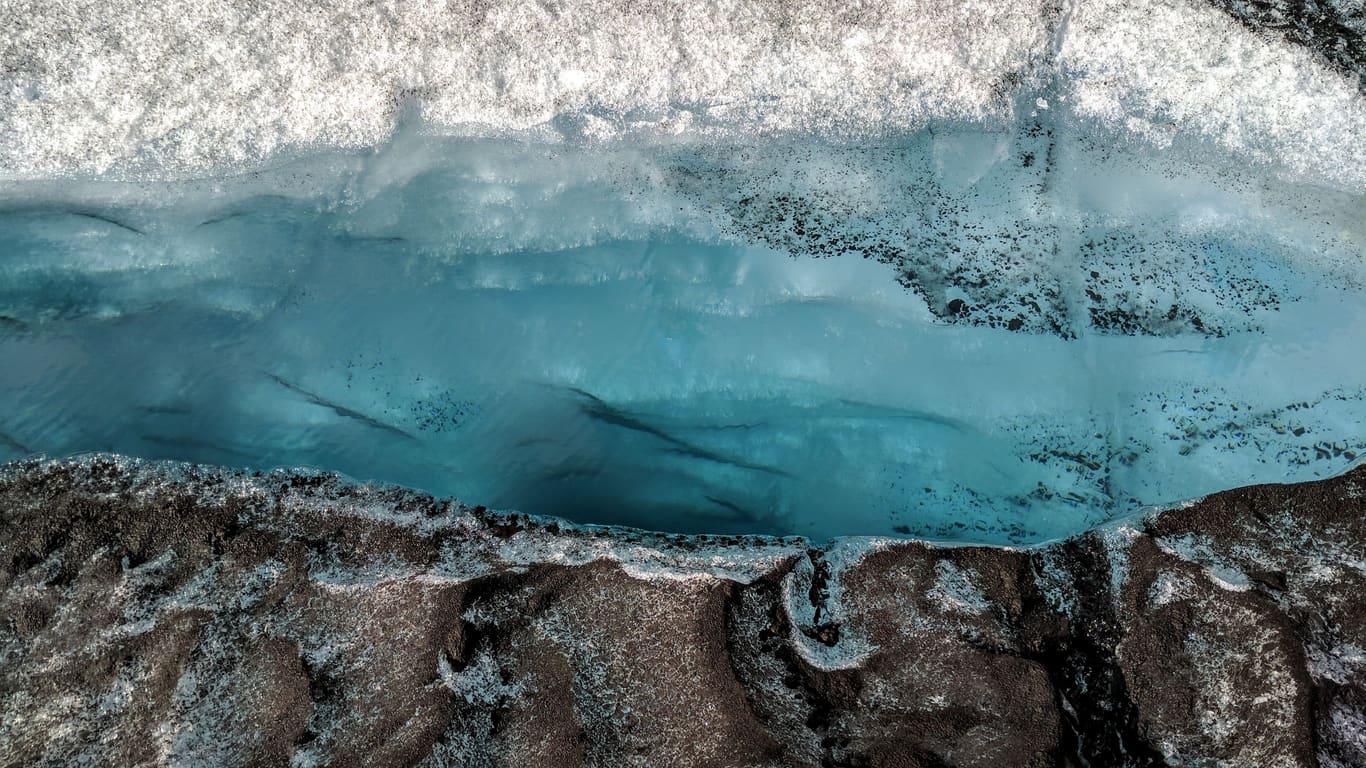
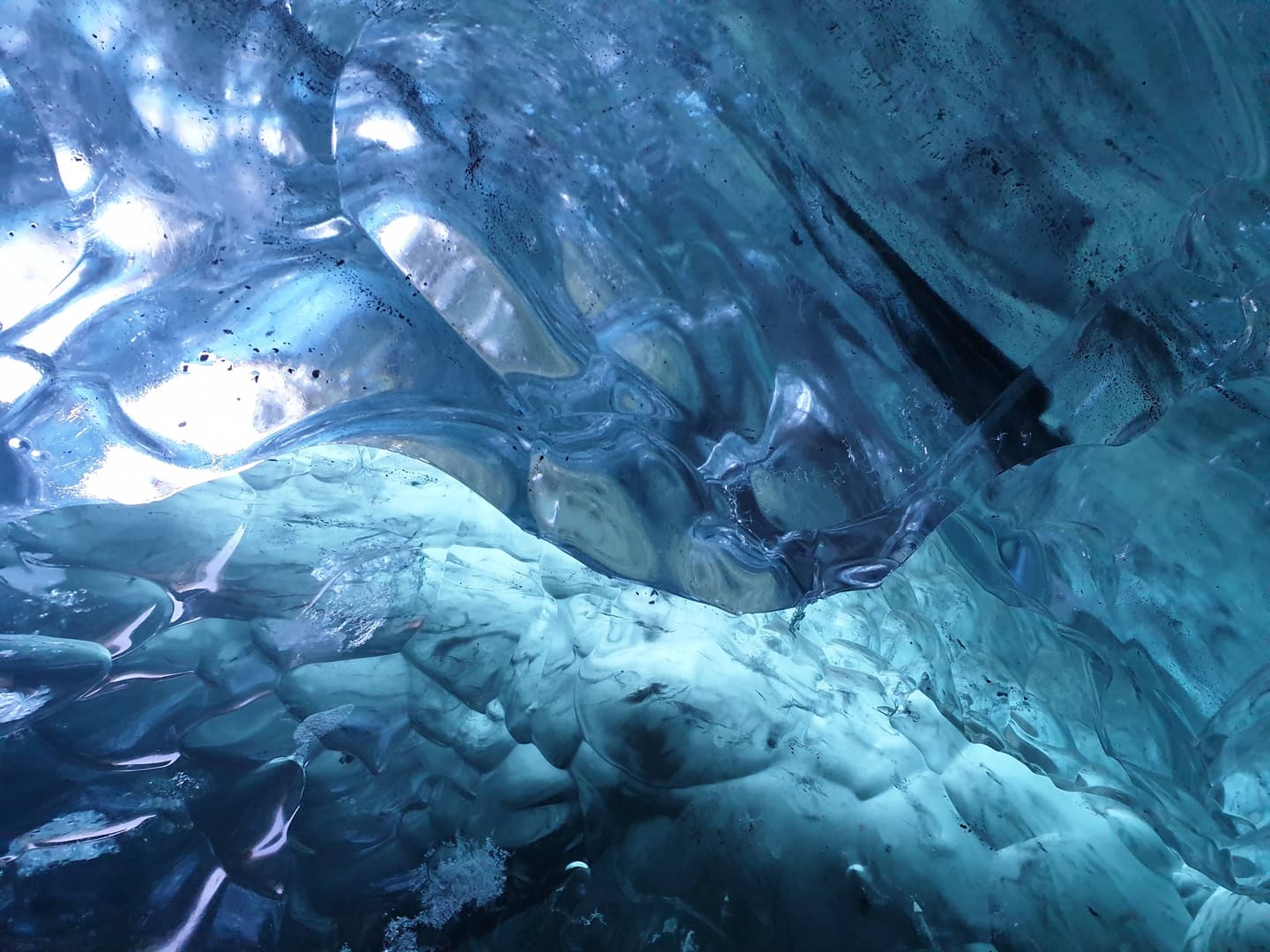
Glacier ice is blue because ice absorbs the red end of daylight a little more strongly than the blue end. In snow and ordinary ice it never shows: light bounces off the air bubbles before much can be absorbed, so every colour returns together as white. A glacier has spent a very long time squeezing the air out of its ice under its own weight, so daylight travels deep into the dense walls, loses its reds on the way, and comes back out blue. The denser, deeper and wetter the ice, the bluer — why the same cave reads muted in October and deepest in January and February. Written by Sindri, who has guided ice cave tours on Vatnajökull since 2015.
I'm Sindri. My wife Fanney and I run Glacier Trips, a small family company in Höfn in South-East Iceland, and I've guided ice cave tours on Vatnajökull since 2015. "Why is it so blue?" is the question I answer most working days, usually with a glove on the wall in question. Here it is written down, no equations attached.
Why is some ice blue and some white?
Start where guests do: the snow on the cave roof is white, the wall under it is blue, and it's all the same water. The difference is air. Ice absorbs light — the red end a little faster than the blue end — but slowly: light has to travel a long way through ice before enough red is gone to notice. Snow never gives it the chance: a snowpack is mostly air, light bounces off the first crystals it meets and comes straight back with every colour aboard — and together they read white.
The sea makes the same point in reverse: a glass of seawater is clear, the deep water off our harbour in Höfn is blue — water, like ice, eats red light over distance. Blue ice is simply ice that light can swim deep into.
Why does glacier ice in particular turn blue?
Because a glacier is a machine for squeezing air out of ice. Vatnajökull's ice began as snowfall, and every winter since has pressed more snow on top; under that weight the buried snow packs down, the air is forced out, and what remains is dense, clear, bubble-poor ice. Think of squeezing a snowball hard enough that white fluff becomes ice; a glacier does that with its whole body, for a very long time.
When daylight enters a cave — through the entrance or down through metres of roof — the dense walls have almost nothing left to bounce it straight back. The light travels, the reds are absorbed, and what returns to your eye is the blue remainder. Nothing is lit or dyed; the colour is what dense ice does to ordinary daylight. How that ice ends up with a walkable cave inside it is in how ice caves form in Iceland; from 1 October to April we guide guests through the drained plumbing of Europe's largest ice cap.

Why is the same cave bluer in January than in October?
Because the surfaces change, not the physics. Early in the season the glacier is still between its summer and winter condition, and a young cave's walls carry air-rich surface ice — the white end of the story. As winter wears on, rain and meltwater wash the walls down to the dense ice underneath, and the blue deepens. Across our season, 1 October 2026 to April 2027, it usually moves like this:
| Months | How the blue reads | Why |
|---|---|---|
| October–November | Muted — real caves, quieter colour | Young, air-rich surface ice; the glacier is between its summer and winter condition |
| December | Deepening | Cold firms the ice; wet weather washes the walls toward denser ice |
| January–February | The prime window — the season's deepest blue | Dense, bubble-poor walls at their cleanest and wettest |
| March–April | Still strong early; caves thin toward late April | A thinning roof passes more plain white daylight; the season ends on conditions |
Weather nudges the colour day to day inside those bands. Fresh snowfall on a cave roof dims the glow — a snow layer is a curtain of bubbles over the light — while a day of rain washes the dense ice clean so it glows, the quiet consolation of the wet months. What one winter does to a single cave is traced in what happens to an ice cave across one winter.
What are the white streaks and dark bands in the ice?
The white streaks are the air that got away. Compression never removes every bubble, and the survivors sit folded through the ice in ribbons and bands — white brushstrokes through the blue, white for the same reason snow is: where air lives, light bounces straight back.
The dark bands are Iceland's signature: volcanic ash from old eruptions, dropped on the glacier, buried by snow and folded into the moving ice. A cave carved through that ice wears them as thin dark curves in the blue. In the caves we guide, the ash usually stays thin and the blue stays in charge; why some Icelandic glaciers carry far heavier banding is also in how ice caves form.
Does blue ice mean the cave is safe, or old, or special?
No, and worth saying plainly: the colour gets sold hard. Blue is physics, not a quality grade. A deeply blue cave can be the wrong cave to enter that morning, and a paler one the safe, roomy, more interesting one: colour is about bubbles and density; safety is about roofs, water and weather. That call happens before you ever see the ice — cave conditions are checked every morning — together with the other local operators and Vatnajökull National Park — before any group goes in. How we decide which ice cave to visit each day shows what actually picks the day's cave; shade of blue isn't on the list.
Blue isn't a thermometer or a birthday either. Guests brace for a deep freeze and stand in a cave sitting around 0 °C all season — much like the −2 to +4 °C a mid-winter day runs outside, minus the wind. The colour certifies density, nothing more, and I won't promise a shade on a date: the season sets the odds, the day sets the result.
How do you see the blue at its best?
Stack the odds, then take the day. If the colour is the point, aim for January or February, with December and March as strong neighbours — the best month to visit an ice cave weighs colour against roads, daylight and crowds. Hope for cloud: overcast daylight filters through the roof as an even, saturated glow, while hard sunshine blows out the entrance. The best light for ice cave photography explains that properly, and the camera settings guide stops auto white balance from correcting the blue away.
Then choose your time with the ice. The short tour is built around roughly 30–45 minutes inside the cave; Adventures Dream gives about 45–60 minutes inside plus a glacier hike, where the blue shows as daylit walls instead of a glowing roof. Torn between the two, glacier hike or ice cave tour is the honest comparison. If your dates land in summer, the blue caves don't exist then; the wider map, year-round alternatives included, is our guide to ice caves in Iceland.
Booking a guided ice cave tour
Both tours meet at the main parking area by Jökulsárlón Glacier Lagoon, where a parking fee applies. We don't do pickups, so nearly everyone drives.
- Ice Cave Inside Vatnajökull — 2.5–3 hours, maximum 14 guests, minimum age 8, 23,900 ISK. Includes a local guide, Super Jeep transport from Jökulsárlón to the glacier and back, micro spikes when needed, helmet, and headlamps if needed. Arrive 20 minutes before departure.
- Ice Cave Adventures Dream — 5–6 hours, maximum 8 guests, minimum age 14, 36,900 ISK. Adds a guided glacier hike, crampons, a harness when the route needs one, and an ice axe when needed. Arrive 30 minutes before departure.
The minimum ages are set by the safety plan we make for each tour, and the season runs October to April. Cancellation is free up to 48 hours before departure with a full refund; inside 48 hours there's no refund; and if we're the ones who cancel for weather or safety, you choose between a full refund and a free reschedule. The base price is the same with us as on the booking platforms, so use DIRECT5 for 5% off when you book direct. Practical questions live in the tour FAQ and on our safety page; the rest goes to info@glaciertrips.is or +354 779 2919. We hold 4.9 stars across 580+ TripAdvisor reviews; the blue deserves a share of the credit.
Frequently asked questions about blue glacier ice
Why is glacier ice blue?
Ice absorbs the red end of daylight a little more strongly than the blue end. Glacier ice is dense and nearly bubble-free, so light travels deep into it, loses its reds and comes back out blue. The denser and wetter the ice, the deeper the colour.
Why are ice caves blue inside?
Daylight reaches the cave through the entrance and the ice roof. Light filtering down through dense ice arrives with its reds absorbed, so the chamber glows blue. Nothing is lit or dyed — on an overcast day the glow is often most even.
When is the ice at its bluest?
January and February are the prime window. October caves read less blue while the glacier is still between its summer and winter condition; the colour deepens from December, and March stays strong before the caves thin in late April.
Does sunshine make an ice cave bluer?
Usually the opposite. Overcast daylight filters through the roof as an even, saturated glow; hard sun blows out the entrance. Fresh snow on the roof dims the blue; rain washes the ice and deepens it.
What are the white and dark stripes in blue ice?
White streaks are bands of surviving air bubbles folded through the ice as the glacier flows — air bounces light back, so they read white. Dark bands are volcanic ash from old eruptions, buried by snow and carried inside the glacier.
— Sindri
Glacier Trips · Höfn, Iceland · A local family company since 2015