· photography · 11 min read
Can You Bring a Tripod Into an Ice Cave in Iceland? Yes — and How
Yes — tripods are allowed on both our ice cave tours. The honest arithmetic of setup time on each, and what kind of tripod works on hard glacial ice.

Yes — you can bring a tripod into an ice cave in Iceland: tripods are allowed on both of our tours, no photography fee, no special product to book. The honest caveat is time rather than permission: on the short tour, up to 14 guests move through the cave at group pace, so the tripod comes out when the group stops and earns its carry only if you set up and pack down fast. On Adventures Dream, eight guests at most across a 5–6 hour day, there is meaningfully more room to work. Written by Sindri, who has guided ice cave tours on Vatnajökull since 2015.
I'm Sindri. My wife Fanney and I run Glacier Trips, a small family company in Höfn in South-East Iceland, and I've driven guests from Jökulsárlón into the caves of Vatnajökull every winter since 2015. I also take most of the photographs we publish, so after eleven winters guiding on Vatnajökull I know first-hand where a tripod helps in these caves and where it just slows you down.
Can you bring a tripod into an ice cave in Iceland?
Yes, on both of our tours: no rule against tripods, no gear check at the Super Jeep, no surcharge. We used to run a separate photo-focused tour and no longer do; tripod permission never depended on it.
What decides whether yours leaves the bag is time. You spend roughly 30–45 minutes inside the cave on the short tour on a settled day, and usually about 45–60 on Adventures Dream; how long you spend inside an ice cave explains why. On the short Ice Cave Inside Vatnajökull tour you share those minutes with up to 13 other guests. The guide stops at the places worth photographing, and those stops are your tripod windows: two or three setups is a realistic day, not a dozen. On Adventures Dream you usually get a little more cave time, the group is eight at most and the day runs 5–6 hours, so nobody queues behind you and the glacier hike adds surface shooting.
So: bring it on either tour if you work fast, and with confidence on Adventures Dream if tripod work is part of why you're coming. The guide to ice caves in Iceland is the wider map, and group sizes and crowding covers sharing a cave with other groups.
When does a tripod earn its place inside an ice cave?
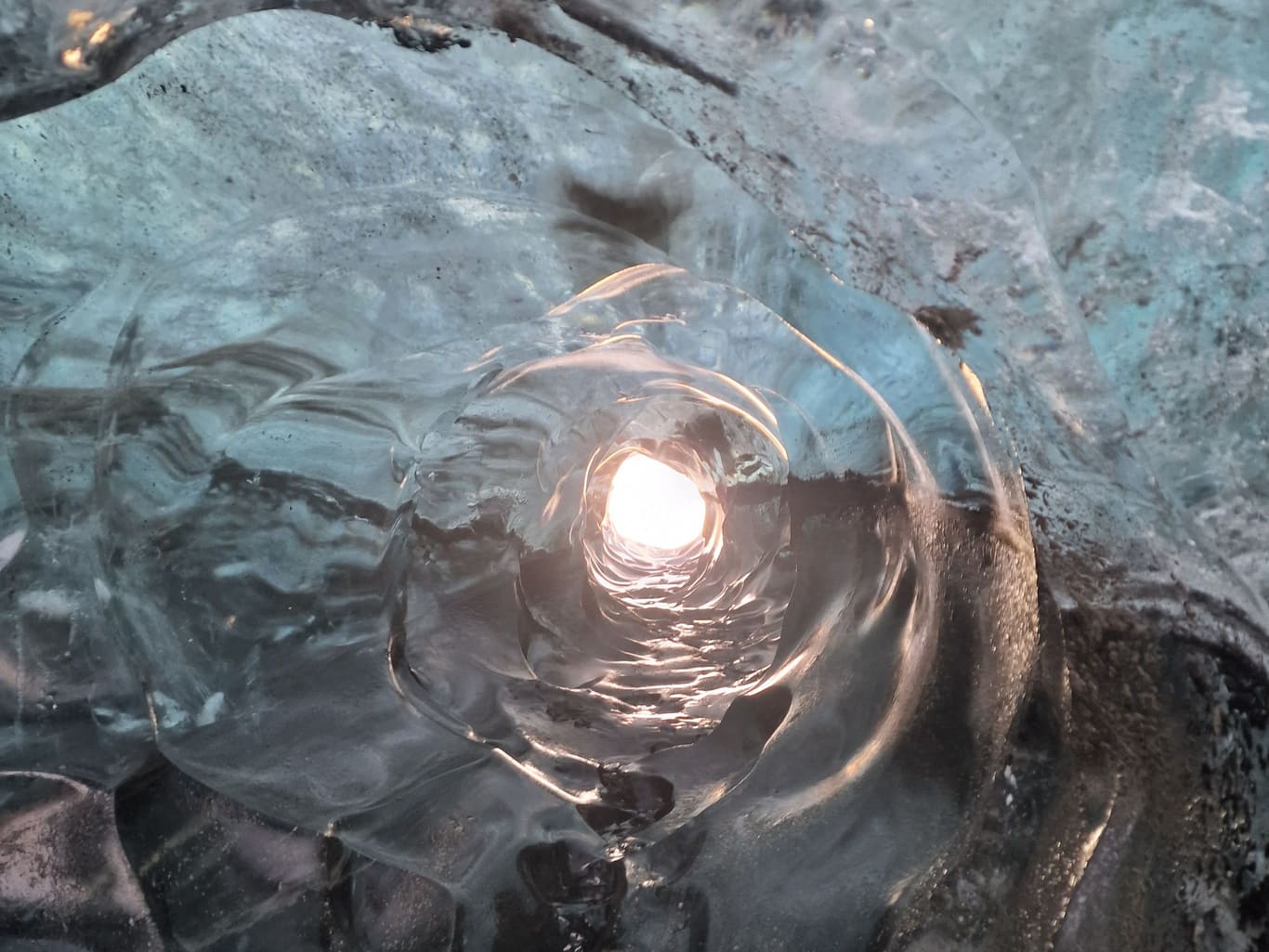
Deep in a cave the light is far dimmer than the photographs suggest, and a frame at base ISO with real depth of field often wants whole seconds of shutter:
- Long exposures. Past about 1/15 second handheld, motion blur creeps in; cave interiors regularly ask for exposures from 1/4 s up to a couple of seconds to hold the wall texture and the depth of the blue.
- Bracketed HDR. A bright entrance against a dark back wall exceeds one exposure, and brackets only blend if the camera hasn't moved.
- Low-ISO files. Clean ISO 100–200 frames for big prints push shutter speeds far past handheld.
- Focus stacking. Sharp ice a metre away and a sharp far wall need several frames focused at different distances.
- Photos with you in them. Self-timer plus tripod, without turning the guide into your photographer.
| Shot | Tripod? | Why |
|---|---|---|
| Long exposure of walls or meltwater | Yes | Seconds-long shutters are the norm deep in the cave |
| Bracketed HDR at the entrance | Yes | Frames must align to blend |
| Low-ISO frames for large prints | Yes | Shutter drops far below handheld speeds |
| Daylight shots near the entrance | No | Usually fast enough handheld at moderate ISO |
| Phone photos | No | Night mode stacks exposures for you |
Apertures, ISO ceilings and white balance in blue light are in photographing ice caves: camera settings.

When can you skip the tripod?
More often than photographers expect. Near the entrance, daylight bounces in and f/4 at ISO 400–800 often shoots handheld; in-body stabilisation stretches that further.
Phones are their own answer: night mode stacks exposures and beats a handheld camera in dim light more often than camera owners like to admit. On a phone, skip it unless you want a deliberate long-exposure look.
The honest short-tour case: if the pictures are a bonus rather than the point, a tripod spends most of the visit on your shoulder. Bring a light one or none at all.
What kind of tripod works on ice?
Not an expedition rig: a light travel tripod around 1–1.5 kg does everything an ice cave asks of it. What matters:
- Weight. You carry it through the Super Jeep, across the ice and through the odd low crouch. Much past 1.5 kg and you'll resent it.
- Leg locks. Twist locks work with gloves on; flip locks are fiddlier in the cold and collect ice. It's cold enough in there that gloves stay on.
- Feet. Plain rubber. The floor is hard glacial ice, not snow, and rubber grips it better than you'd expect. Micro spikes (short tour, when needed) and crampons (Adventures Dream) keep you upright, but nobody makes crampons for tripod legs, and none are needed.
- Centre column. Keep it down; wide-splayed legs at low height are steadier on an uneven floor.
- Head. A small ball head with one locking lever beats a three-way pan-tilt in gloves.
Carbon fibre is lighter than aluminium at the same stiffness and kinder to cold fingers, but the aluminium tripod you own beats the carbon one bought in a panic at the airport.
How do you set up a tripod inside the cave?
The routine that works:
- Set up before you enter. Extend and lock the legs to rough height outside the cave mouth; cold fingers fumbling with locks in a narrow passage waste the minutes you came for.
- Go low and wide. Cave floors are rarely level, and splayed legs absorb the tilt.
- Use the 2-second self-timer or a remote. Pressing the shutter shakes the camera enough to soften a long exposure.
- Mind where the legs sit. Other guests pass through the same spaces; set up out of the walking line and lock everything tight.
- Pack down before the guide calls the move. Watch the group between frames; when people start gathering, queue your last exposure. Don't be the reason fourteen people stand still in the cold.
Dress warmer than you think: tripod photography is standing still, and standing still is where the cold finds you. What to wear on an ice cave tour covers the layers.
Which tour fits tripod work?
Neither tour is a photography workshop; they differ in how much room the day leaves for one.
The short tour, 2.5–3 hours at 23,900 ISK with up to 14 guests, fits photographers for whom the pictures are one part of the visit. You'll get your stops, but the group sets the rhythm, not your histogram.
Adventures Dream, 5–6 hours at 36,900 ISK with eight guests at most, is the one I point tripod owners toward: a little more cave time, far fewer people sharing it, a less compressed day, and a glacier hike where the surface gives a tripod a second shift. The best ice cave tour for photography makes the fuller comparison, and the best month to visit weighs the season's light.
Off the ice, Jökulsárlón and Diamond Beach sit minutes away, open to anyone with a tripod and patience.
Booking a guided ice cave tour
Both tours meet at the main parking area by Jökulsárlón Glacier Lagoon, where a parking fee applies. We don't do pickups, so nearly everyone drives.
- Ice Cave Inside Vatnajökull — 2.5–3 hours, maximum 14 guests, minimum age 8, 23,900 ISK. Includes a local guide, Super Jeep transport from Jökulsárlón to the glacier and back, micro spikes when needed, helmet, and headlamps if needed. Arrive 20 minutes before departure.
- Ice Cave Adventures Dream — 5–6 hours, maximum 8 guests, minimum age 14, 36,900 ISK. Adds a guided glacier hike, crampons, a harness when the route needs one, and an ice axe when needed. Arrive 30 minutes before departure.
Our 2026–27 season runs from 1 October 2026 to April 2027 (season preview). Cancellation is free up to 48 hours before departure with a full refund; inside 48 hours there's no refund; if we cancel for weather or safety, you choose a full refund or a free reschedule. The base price is the same direct or through a platform, so use DIRECT5 for 5% off when you book direct. The rest is in the tour FAQ and what's included; anything else, info@glaciertrips.is or +354 779 2919. We hold 4.9 stars across 580+ TripAdvisor reviews.
Frequently asked questions about tripods in ice caves
Can you bring a tripod into an ice cave in Iceland?
Yes. Tripods are allowed on both Glacier Trips tours, with no photography fee. On the short tour (max 14) you get a couple of setup windows when the group stops; Adventures Dream, with eight at most, leaves meaningfully more room.
Are tripods allowed on the short ice cave tour?
Yes. On the 2.5–3 hour tour the group of up to 14 sets the pace, so expect two or three tripod moments when the guide stops. Bring one if you work fast; otherwise shoot handheld.
Do I need a special cold-weather tripod?
No. Any sound modern tripod handles an Icelandic winter. Twist leg locks are easier to work in gloves, and brush snow off the legs before extending them so the locks don't ice up.
Can I rent or borrow a tripod from Glacier Trips?
No — we don't offer tripod rental or loan, so bring your own. A light travel tripod around 1–1.5 kg covers everything an ice cave asks, and a phone's night mode covers most shots without one.
What about smartphone tripods and gimbals?
A small phone tripod is fine for long-exposure phone shots and takes no space. Gimbals add weight for little gain; handheld video inside the cave is smooth enough with modern stabilisation.
Will my tripod legs damage the cave floor?
No. The cave floor is hard glacial ice, not snow, and standard rubber feet leave no mark on it. What matters is placement: set up out of the walking line so nobody clips a leg.
— Sindri
Glacier Trips · Höfn, Iceland · A local family company since 2015